
(NOTE: Because I can't get screenshots from DS games, I'm stealing them from IGN. All credit goes to them.)

By the end of the game, you'll long for the days when this was all you had to deal with.
I'm going to be honest with you. I haven't beaten this game without cheating. Normally, you might wonder how someone could review a game without beating it legitimately. Play Contra 4 and you won't wonder anymore. To someone who doesn't write video game reviews for a living, it's asking a lot.
If you were around for the days of "old-school gaming" -- approximately 1985-1995 -- you're well aware of the fact that a lot of old games were really, really hard. One of the main reasons for this is that they were also really, really short. Video games basically started in the arcades, and if you'd been able to beat them on the first try, they wouldn't have been very profitable. The move to home consoles eliminated the pay-to-play system, but old design habits die hard, and technical limitations on game size still encouraged designers to increase play time in other ways.
The merits of the "Nintendo Hard" design philosophy are to this day a subject of great controversy (among nerds). Go too far in one direction and you get games that simply aren't fun to play; you never even get a chance to start liking the game before you hit Game Over. (See
Shadow of the Beast for an unfortunate example; the art design was some of the best ever seen in gaming, but it was so unplayable that they actually publicized an invincibility cheat code to make up for it.) Go too far in the other direction and you get games that everyone can reach the end of, but provide so little challenge that they might as well be movies. So where's the happy medium? Well, I could go in-depth and write an essay, something I've had my fill of in the first 22 years of my life, or I could just say "Mega Man 9 and Contra 4". Specifically, let's talk about Contra 4.

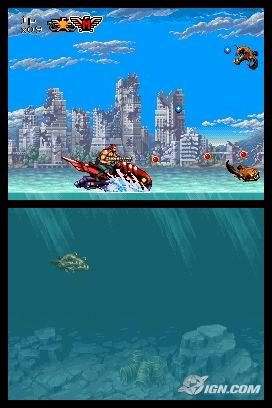
Why is he riding a jet-ski? Why are there evil fish? Do you care?
There have actually been many Contra games betwen Contra 3 and Contra 4. Most of them were so misguided that Contra 4's manual actually makes fun of them. PS2's
Shattered Soldier, however, was a really cool, insanely hard, side-scrolling Contra game whose only failing was the "2.5D" style. I would've preferred true 2D, but it still looked and felt like a true Contra game and not one of those 3D abominations. Regardless, Konami has decided to go with "Contra 4" as the title for this latest entry, and while I feel kind of bad for
Shattered Soldier, the idea here is to stick even more strictly to the old-school design philosophy, and it's certainly appreciated. It also feels completely genuine.
But... it's a DS game. You may be thinking, surely they added some lame touch-screen mechanic that's totally uncalled for, or used the second screen for nothing other than displaying a map. Surely there's no reason for it to be on DS, other than the fact that DS is technologically superior to, and more popular than, Game Boy Advance. Well, that's sort of true and sort of not true. The touch-screen isn't used for anything other than an optional way of navigating the Contra Museum menus, and that's just fine with me. Just because a system has a feature doesn't mean you have to use it, and it would make no sense in a game like this. It's no bigger issue than simply not using all of the system's buttons. (Although on that note, I wish they would've left the A button alone as well instead of making it drop your weapon. WHY WOULD YOU EVER DROP YOUR WEAPON IN A CONTRA GAME. WHY??) However, the game does use the second screen rather well. The playing field is super-tall, just like in certain old arcade games. It's not 100% necessary, but they designed the levels around this setup and it's ultimately non-intrusive to the Contra experience. It also allows for some MONSTROUS boss sprites, which is justification enough.

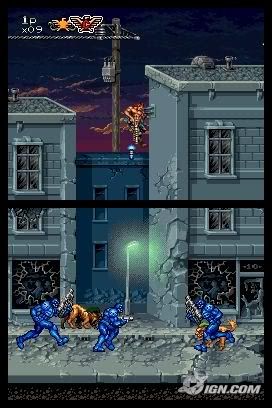
We need to keep violence off the streets.
WITH ROCKETS!
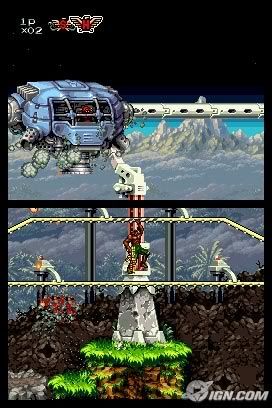
Contra 4 is a thesis statement on the merits of old-school game design, and it's an emphatic one. It's mercilessly difficult -- more on that later -- and it has virtually no storyline. Everything in the game is designed around the most interesting way to make things blow up. This illustrates one definitive advantage of the 2D, side-scrolling perspective that makes it relevant in this age of complex 3D environments: working in 2D, the designers are free to throw in any outlandish set piece that comes to mind and the player is able to traverse it without needless re-training. For example, this game contains a sequence where you climb onto a nuclear missile as it launches, fight a giant robot that clings to the side of the missile, jump from handle to handle as they appear and disappear from the missile's surface while shooting down smaller missiles, climb onto the exhaust of the missile as it heads back down to Earth, dodge the exhaust flames that flare up intermittently, crash-land between two buildings, and then fight the giant robot again. If that sounds confusing, it would be -- in a 3D game with a target lock-on system, controllable camera, and tricky jumping perspectives. Here, it's just another series of platforms to traverse and more stuff to shoot. Undeniably, 3D games have the advantage of increased immersion, the sense that you're "really there" in a fully developed world, and that should never be dismissed as some sort of modern tech fad. But 2D games still have the advantage of being able to throw something completely audacious at the player without missing a beat. When it comes to fast, twitchy action where one missed move equals death, you can't beat 2D.
Which brings up the subject of difficulty. This game is absolutely brutal, and that can't be overstated. Casual gamers need to heed this warning, because it is
very possible that you will be unable to finish this game, and if that's something that bothers you, prepare to be bothered. In true Contra tradition (Contradition?), one hit from anything is an instant kill, and if you run out of lives, you have to continue either at the beginning of the level or at a midway point. And if you run out of Continues, goodbye. It's just as hard as any arcade game I can remember, and getting all the way to the end without cheating is proof positive that you're a hardcore gamer. (Which is why I haven't managed to do it yet.) Fortunately, because it's structured like an arcade game, you're guaranteed to be able to get
somewhere before Game Over. You'll always get just enough of a taste for the action that you're motivated to push yourself a little further next time, and as you practice each stage, you eventually do improve. There is frustration, to be sure, but if you go into the game without necessarily expecting to beat it any time soon, it's a good time.
I should also point out the differences between Easy Mode and Normal Mode, two subsets of Arcade Mode (a.k.a. the actual game). Easy Mode is drastically different from Normal Mode. Weapons automatically start at level 2, out of 3 possible levels that are normally achieved by collecting the weapon power-up multiple times. You also have more lives, meaning you don't have to start over at the beginning or half-way point of a level quite so often. The levels themselves are missing many key obstacles, such as firing turrets and various other things in the background that kill you. But most importantly, you can't even play the final 2 stages in Easy Mode. So Easy Mode is basically a training session for the real game, and it works well. Most pseudo-hardcore gamers should be able to beat it with enough persistence. But Normal Mode is the real meat and potatoes here, and it will put you to the test. There's also some sort of "Hard Mode" option on the menu, which you should probably just ignore altogether.

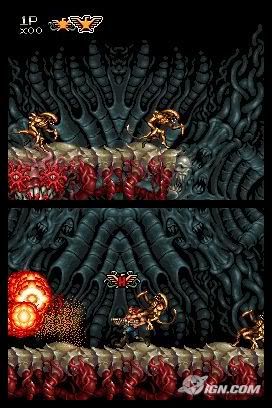
You may never actually see this stage.
One feature of the game that alleviates this extreme difficulty, giving the game a bit of an advantage over other Contras, is the Challenge Mode. This mode is unlocked if you beat the game on Easy Mode, and it's a welcome spin on the classic Contra action. It consists of 40 challenges such as "Pacifism" (where you can't use weapons), "Speed Run" (where there's a time limit), and "Friendly Fire" (where there are actually things you SHOULDN'T shoot, for once). Each challenge requires you to complete a small chunk of the game under one of these conditions.
After investing several hours of your time attempting to beat Arcade Mode, Challenge Mode is a welcome breather. It allows you to repeat one tiny section of the game over and over again, limited to one life, without having to worry about the extremely daunting task of completing the whole thing. They're also good practice runs for the actual game, since many of the challenges take place on portions of the regular stages. This is especially useful for those later portions of the game that always wind up killing you (on the rare occasion that you actually make it that far). In fact, attempting to beat Normal Mode without practicing the final level in this mode is just plain suicide. Challenge Mode also rewards you frequently; for every 4 challenges you complete, you unlock one of several bonuses, including two original Contra games, an interview, a comic, new playable characters (including a female soldier with what might be described as "next-gen" attire), and more. Plus, you start out with several challenges available and each one unlocks another one, so you rarely get stuck with just one challenge that you can't manage to beat.
If you're a fan of Contra, this is a must-own. If you're a strictly modern gamer, I still recommend this game because it represents some of the best aspects of old-school gaming, but you also need to be warned that it's probably the hardest game you're ever going to play. Still, it's much more refined than some of those old games that are needlessly difficult to the point of masochism, and you'll have a good time playing it even if you don't ever manage to actually beat it. If you're looking for a challenge, this is it.
For those of you who are curious, I didn't cheat intentionally. I died at the same time as a boss did, and I wound up with 99 lives. Apparently this happens if you get an extra life at the same time as losing your last one. I only had 9 of these lives left at the end of the game. Yeah.
Perhaps it's a testament to this game's design that I still want to beat it the real way, despite its overwhelming difficulty. Beating it without having to worry about continues eliminated a fair amount of the urgency and challenge in those later stages, and a part of me still wanted to be able to die, because I didn't feel a real sense of accomplishment. This stands in stark contrast to something like
Shadow of the Beast, where cheating is the only way to enjoy it.




 Posts
Posts


